.

.

|
Training
for:
Online Strategies provides training in using open sources, particularly
the Internet, for effective and efficient information collection for
OSINT (Open Source Intelligence) applications.
Online Strategies' OSINT seminars are presented at the customer's
site and have been given to a variety of governmental agencies
and ministries of three countries, and also to companies, associations,
and conferences.
Course content is tailored to the specific customer and the
length of courses can range from one to three days.
|
Seminars usually consist of a combination of the following modules:
Overview of OSINT on the Open Web
Some Key Intelligence "Starting Points"
Internet resource guides for intel professionals
Web Searching Strategies
Frameworks for structuring searches and strategies
Evaluating the Quality of What You Find on the
Internet
Traditional evaluation criteria and techniques extended
into the Web context
Site Investigation Tools
Tools useful for determining the authenticity, origin, and
validity of individual websites and their content
Web Searching Tools - Web Search Engines
A detailed examination of features, techniques, and tools
available in the major search engines, including Boolean,
field searching, and a variety of special features such
as language tools, “web definitions”, “shortcuts”,
etc
Visualization and Clustering Search Tools
What these tools are and the unique search perspectives
and results they provide
The Deep Web (Invisible Web, Hidden Web)
Why the majority of pages actually available on the Web
may not be found by search engines and how that problem
can be solved
Resource Guides and Portals
Specialized subject guides to Web content – a way
of gaining some immediate Web “expertise” in
any subject area
News Resources - The Epitome of "Open Source"
How to easily locate, access, and search newspapers, news
networks, blogs, and other news resources.
RSS Feeds
Having news, blogs, and other information automatically
delivered to you. |
Accompanying
materials provided
for each attendee:
-
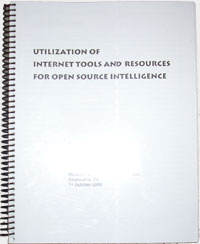
Spiral bound booklet (approximately 160 pp.)
for use as notes during the session and as a resource
guide afterward
-
Webpage containing links for all websites
covered in the session. ( Example)
This is available to attendees both during and after
the session.
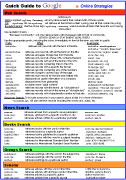
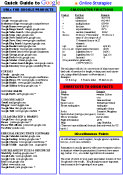
- Laminated Quick Guide to Google.
|
|
| Alerts
Using automatic alerting services provided by search engines,
plus an examination of programs that can immediately alert
users to changes in any public webpage.
Discussion Groups (News Groups, Forums, etc.)
How to identify and access this immense body of material
and easily find the hidden jewels of valuable information.
Searching for People
Techniques and resources for finding information on individuals.
Searching Social Networking Sites
A brief look at searching major sites such as Twitter, Facebook,LinkedIn,
etc.
Image Searching
Finding images using image search engines and other resources
such as Flickr.
Audio
Finding radio stations, podcasts, speeches, etc.
Video
Searching for video using major search engines and other
resources such as YouTube.
Languages and the Internet
The variety, power, capabilities, and limitations of translation
and other language tools available on the Internet
Anonymity
A brief look at the issue of searcher anonymity, its implications,
and tools that are available to address the problem
Selected Topical/Geographic OSINT Sources on the Web
This is a brief sampling of resources available for selected
regions, countries, and special topics. |
|
For a sampling of the kinds of websites typically covered, see onstrat.com/osint
The Instructor:
Randolph Hock, Ph.D.
For
the last sixteen years Ran Hock has been creating and presenting
courses on using the Internet effectively for research. Over his
career he has trained over 15,000 online users in thirteen countries,
including presenting OSINT courses for intelligence agencies of three
countries and courses for major international organizations. Ran is the
author of eight books on using the Internet and is a frequent
contributor and columnist for professional publications.
Ran has held management and training positions with DIALOG and
Knight-Ridder Information Services, and has been a reference librarian
at MIT and the University of Pennsylvania. In addition to his training
and writing activities, from 2007-2010 he served as an adjunct faculty
member for the Johns Hopkins University Masters Degree Program in
Intelligence Analysis (Division of Public Safety Leadership) and
currently serves as adjunct faculty for at The Catholic University of
America where he teaches the course, "Actionable Intelligence:
Information Analysis and Communication".
Ran is active in the American Society for Information Science and
Technology for which he has served on the Board of Directors, and
chaired committees and chapters, and is also a member of the
International Association for Intelligence Education. Ran's biography
has appeared in Who's Who in America and he is a recipient of OSS.NET's OSINT Platinum Candle Award
To inquire about courses, call 855-244-0400 (from within the U.S.)
or 001.410.224.0400 (from outside the U.S.) or email Ran at ran@onstrat.com.
|